| | | WHISKEY & WHISKY | The Full List of Whisky Brands
| | The word ‘whiskey’ derives from the Gaelic ‘uisque
beatha’, meaning ‘water of life’ and whiskies are distilled in countries around the world including Scotland,
Ireland, USA, Canada, Australia, Japan. The spelling varies between countries with the ‘e’ either included or omitted (though
‘whiskey’ is the spelling for whiskies in general). Each country produces a different style using a slightly different method.
However, all whiskies are made from grain. To be precise, beer is fermented from the grain with the help of yeast and this is distilled
to make a spirit.
After a period of ageing, this becomes a whiskey, which is then almost always blended with the contents of other barrels
to create the finished product.
The many flavors found in different whiskies of the world are affected by the local water, type of grain, the way the grain
is processed, the method of distillation, the ageing process and, of course, blending. Other factors, such as the yeast used, also
play a part |
| | | ▲ | U.S. WHISKIES Canadian | Irish | Japanese | | Scotch Maslt | Scottish Blended | | | Towards the end of the 18th century,
as the lands below Virginia became available for settlement, the governor, Thomas Jefferson, offered sixty acre plots of
land in Kentucky County to pioneers.
Most of these early settlers were Scottish and Irish immigrants escaping from famine in the British isles. Many were smallhold farmers who in Britain had
produced rye and wheat.
No family could consume the harvest of 60 acres, nor could they transport it to any of the potential markets. The answer lay in distillation
– turning the grain into easily transportable spirit. The whole area from Northern Kentucky through Southern Indiana into Northern
Tennessee exist on a geological shelf or limestone that provides excellent spring water, free of iron and other minerals,
making it particularly suitable for whiskey making. With the availability of both suitable pastures and a network of river transportation,
the area was perfect. 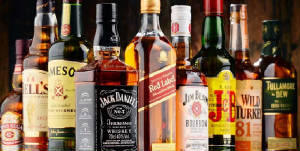 |
| | Bourbon History According to
legend it was the Reverend Elijah Craig who first discovered the burnt barrel method of ageing the
whiskey we now know as Bourbon. A distiller of note, he was supposedly warming oak staves over a fire to make a barrel, when
he was interrupted.
On his return he found the wood had heavily charred. All the same he finished his half-burnt barrel and filled it with whiskey.
Another, more believable story is that he had a barrel that had been used to store fish. Rather than discard the barrel he
burn it to remove the smell. However this happened, the barrel contained a greatly improved whiskey. The ageing process in charred wood
produced a darker, mellower spirit with a vanilla sweetness that was the best of the batch. When Craig’s distinctive dark
colored whiskey was sent down the river to New Orleans numerous request came back for the ‘whiskey from Bourbon’,
a reference to the stamp place on the barrels at the port of Mayville, Bourbon County, where his product was shipped down
the river. 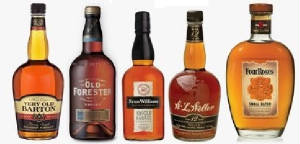 Bourbon Whiskey
- For a whiskey to be Bourbon, it must be produced in a specific way. Bourbon must contain at least 51% corn(but not more
than 80%), be distilled to a strength of not more 80%alc./vol., be store in charred, new white oak barrel at a strength
no higher than 62.5%alc./vol., and aged at least two years, and be reduced at the time of bottling to no lower than 40%alc./vol. 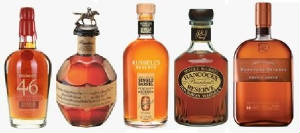 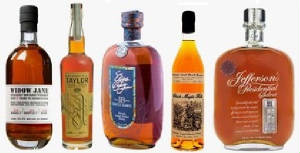
Outstanding
brands: Baker’s,
Basil Hayden’s, Booker’s, Blanton’s, Four_Roses_Yellow_Label, Jim_Beam, Johnny_Drum, Knob_Creek, Maker’s_Mark, Old_Crow, Old_Gran_dad, Pappy_Van_Winkle’s, Wild_Turkey, Woodford_Reserve. Tennessee Whiskey
- The main difference between Bourbon and Tennessee whiskey, lies in the Lincoln County Process. In 1820’s someone (possibly
Alfred Eaton) started filtering whiskey through maple charcoal. Tennessee whiskeys are now filtered through 10-12 feet of
maple charcoal before bottling, removing impurities and giving a ‘sooty’ sweetness to the finished spirit. A Tennessee
whiskey must be made from at least 51% of one particular grain. This could be rye or wheat, but most often, as with Bourbon,
corn is the favored base. Outstanding brands: Jack_Daniel’s, George_Dickel. 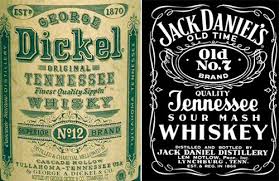  | Corn Whiskey
- A whiskey containing more than 80% corn is known as corn whiskey. Unlike Bourbon or Tennessee whiskey, corn whiskey
is matured in aged, uncharred barrels. Outstanding brands: Mellow_Corn. | 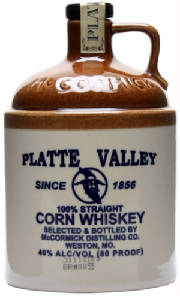
|
| | | ▲ | | | United States CANADIAN
WHISKY Irish | Japanese | | Scotch Maslt | Scottish Blended | | |
Blending is the key to Canadian whisky. It is produced from a wide range of grains: corn is by far the most important, while rye contributes
most flavor.
As a rule, the more spice you smell in a Canadian whisky, the more rye is in its blend. The mash bill (or grain mix) is dependent on the
particular brand a whisky will ultimately form part of (these mash bills are closely kept commercial secrets). The length of distillation
and type of continuous still used also varies according to a particular brand’s style requirements. The myriad options available in terms of basic
ingredients, ageing periods, cask and timing of blending, make Canadian whisky a unique style. 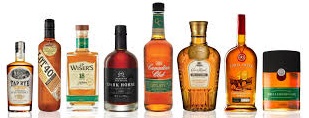
|
| | Canadian Whisky History John Molson,
though better known for brewing, is credited with first introducing whisky to Canada in 1799. His lead was followed by Scottish
emigrants who found their new home had plentiful and cheap grain ( like the Scots, the Canadians spell whisky without the
‘e’).
Whisky production started at Kingston, on Lake Ontario, and spread as farming developed. However, barley was not common, so
they reduced the amount of barley and added corn, wheat and rye instead. Canada’s first legal distillery was founded
in 1832. Outstanding brands: Alberta_Premium , Black_Velvet , Canadian_Club, Crown_Royal, Glen_Breton_rare . Lot_N0_40 | | | ▲ | | | United States | Canadian IRISH
WHISKEY Japanese | | Scotch Maslt | Scottish Blended | | | Irish whiskey
has an undeserved reputation as a harsh, rough spirit only suited to pepping up coffee. It may be great in an Irish Coffee, but rough and harsh it is not. In
fact, the very opposite is true. |
| | Irish Whisky History 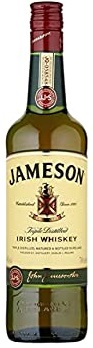
| There is evidence that whiskey
distilling and drinking in Ireland was widespread by the 16th century. However, it is believed that distillation
was practiced much earlier, provably by the 12th century. Some claim that monks in the early Celtic Church were
distilling for medical purposes as early as the 6th century AD, although this date seems extremely early. The English involvement in Ireland dramatically changed the
whiskey industry as it did the rest of the nation. |
On Christmas Day in 1661 a tax of four
pence was applied to every gallon distilled. Still, over the following decades the industry continued to expand, mainly through
illegitimate stills. In the 19th century, the rise of the Irish temperance movement, led by the charismatic Capuchin
friar, Father Mathew, did whiskey no favor. Within six years of Father Mathew’s first pledge(in 1838), more than
one third of Ireland’s drinking outlets were shut down. But Irish whiskey
got its big chance in 1872 when the phylloxera vastatrix louse decimate vines in France’s Cognac region, leaving a
huge gap in the international market for a quality spirit. Yet a whole series of events conspired to check the spirits rapid growth. The Irish war of independence in 1916, followed by the civil war which run between
1919 and 1921, led to the British imposition of trade embargos. Exports to the
British Empire, including Canada, South Africa, India, Australia and New Zealand were banned. Then came American Prohibition (1920-1933). As if this were not enough, the outbreak of World War II
in 1939 led the Irish Government to ban whiskey distilling altogether for the duration of the war.
By 1945, the Irish whiskey industry was in truly catastrophic shape. In 1966, the few remaining Irish distilling companies in
the Republic- Jameson, Powers and Cork Distillers- join forces to form the Irish Distillers Company. During the 1970s, Irish Distillers
acquired Bushmills, the last distiller in Ulster. Even with this union, Irish Distillers were taken over by the French drinks
giant Pernod-Ricard in 1988.
Comparing Irish & Scotch Whiskies
Malting- Most Irish whiskies do not come
into contact with smoke during the malting process, while most Scottish whiskies use the flavor of pet smoke. Hence, the
smoky, peaty flavors of typical Scottish malts are not generally presents in Irish whiskies. Distillation- Most Irish whiskies
are triple distilled, while Scotch is double distilled. This means Irish whiskies are generally lighter in style. Outstanding brands: Black Bush, Bushmills, Connemara, Jameson, Paddy, Tullamore_Dew.... The Full List 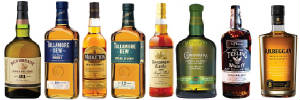
| | | ▲ | | United States | Canadian | Irish JAPANESE
WHISKY ' | Scotch Maslt | Scottish Blended | | |
Two men are regarded as the fathers of Japanese whisky, Masataka_Takesuru and Shinjiro_Torii. Taketsuru studied Applied Chemistry at Glasgow University and spent time working in
Scotch whisky distilleries before returning home in 1920 with a Scottish bride and the secrets of whisky production. It was Torii, the founder
of Suntory, who provided the necessary finance for Takesuru to use his knowledge to create the first modern Japanese whisky. 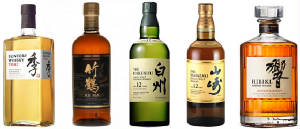
Since the end of
World War II, many young Japanese have aspired to the lifestyle and fashion accessories of the West. Fortunately for the
Scotch whisky industry, this includes whisky. The Japanese whisky industry has grown so quickly that in 1973, only 50 years after opening
Japan’s first ever distillery, Suntory opened the world’s largest whisky distillery with 24 pot stills. Outstanding brands: Hibiki Suntory, Suntory Royal, Nikka ... Full Listing of the Japanese Distilleries >>> 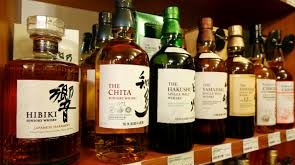 |
| | | ▲ | | United States | Canadian | Irish | Japanese | SCOTCH MALT WHISKY Scottish Blended | | | For a sad period, the delights of single malts
were relatively unknown, with drinkers only likely to consume them as part blended whiskies. The term ‘Single Malt Scotch’ refers to a whisky that fulfils all three elements of the term. Single- The whisky must be from only
one distillery.
Malt- The raw material used must be barley malt. No other grain or fermentable material can be used. The barley malt
is infused with water, fermented with yeast and distilled in a pot still. Scotch- The whisky must be distilled
and matured in Scotland.
Scottish
whisky regions
Single Malt Scotch whiskies are grouped by region, each embracing certain characteristics. The Lowlands - This region
is defined by a line following old county boundaries and runs from the Clyde estuary to the river Tay. The Lowlands tend to produce whiskies in which
the softness of the malt itself is more evident, unaffected by Highland peatiness or coastal salt and seaweed. Outstanding
brands: Glenkinchie, Inverleven, Kinclaith. The Highlands (inc. Islands & Speyside) - By far the biggest region with wide variations
in style, The
Highlands encompass the islands of Orkney, Skye, Mull, Jura and Arran. The western part of the Highlands, at least on the mainland, has only
a few distilleries and due to their scattered nature it is difficult to make generalizations over their character. However,
the whiskies tend to be rounded, firm and dry with some peatiness. The north of the region has several whiskies with a heathery, spicy
character, partly due to their coastal location and heather in the peat. The more sheltered East Highlands and the Midlands of Scotland produce
fruity malts.
Speyside, the main Highland distillation area, lies between the cities of Inverness and Aberdeen. These malts are noted in general for their elegance
and complexity and often have a smokiness. Outstanding brands: The Balvenie, Cardhu, Dalwhinnie, Glenfiddich, The Glenlivet, Glenmorangie, The Macallan, Oban, Talisker. Campbeltown - Situated
on the Peninsula called the Mull of Kintre, Campbeltown was once home to over twenty distilleries. But during prohibition in America, many bootleg
malts were labeled as coming from Campbeltown. The town’s reputation plummeted, and today there are only two distilleries left. These malts are distinguished
by their briny, seaside character. Outstanding brands: Glengyle , Glen Scotia. Islay - Eight distilleries
huddle on this windswept island that is only 25 miles long and lies in the Inner Hebrides. The island produces malts that are noted for their
seaweedy, iodine-like character. Outstanding brands: Bruichladdich, Caol_ila, Lagavulin, Laphroaig. Speyside - some of the
whiskies which are considered to be the most refined and elegant are in Speyside Outstanding brands: The Glenlivet, Glenfiddich, 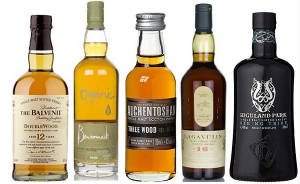 |
| | | ▲ | | United States | Canadian | Irish | Japanese | | Scotch Maslt SCOTTISH
BLENDED WHISKY | |
Blended Scotch whisky, or ‘Scotch’ for short is by far
the most the world’s most popular whisky and accounts for well over 90% of all Scottish whisky. Although malt was the original Scottish whisky, the majority
of pot-still malt whisky is sold in blends, not as single-malt whisky. |
| | Blend Labels A standard blended whisky will probably contain 15-40% malt and have no age
statement.
Some blends describe themselves as ‘deluxe’- this is a reference to the percentage of malt whisky in the blend
and the average age of the whisky. A deluxe brand will usually contain more than 45% pot-still malt and will show an age
statement of 12 years or more. Outstanding brands: Ballantines, Bell’s,
Black_&_White, Chivas_Regal, Cutty_Sark, Dewar’s_White_Label, Dimple, The_Famous_Grouse, J&B, Johnnie_Walker,
Royal_Salute, Teacher’s, Vat_69, White_Horse, William_Grant’s. 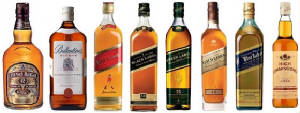 | | | back to top ▲ |
 |
|
|